
Trailblazing Women
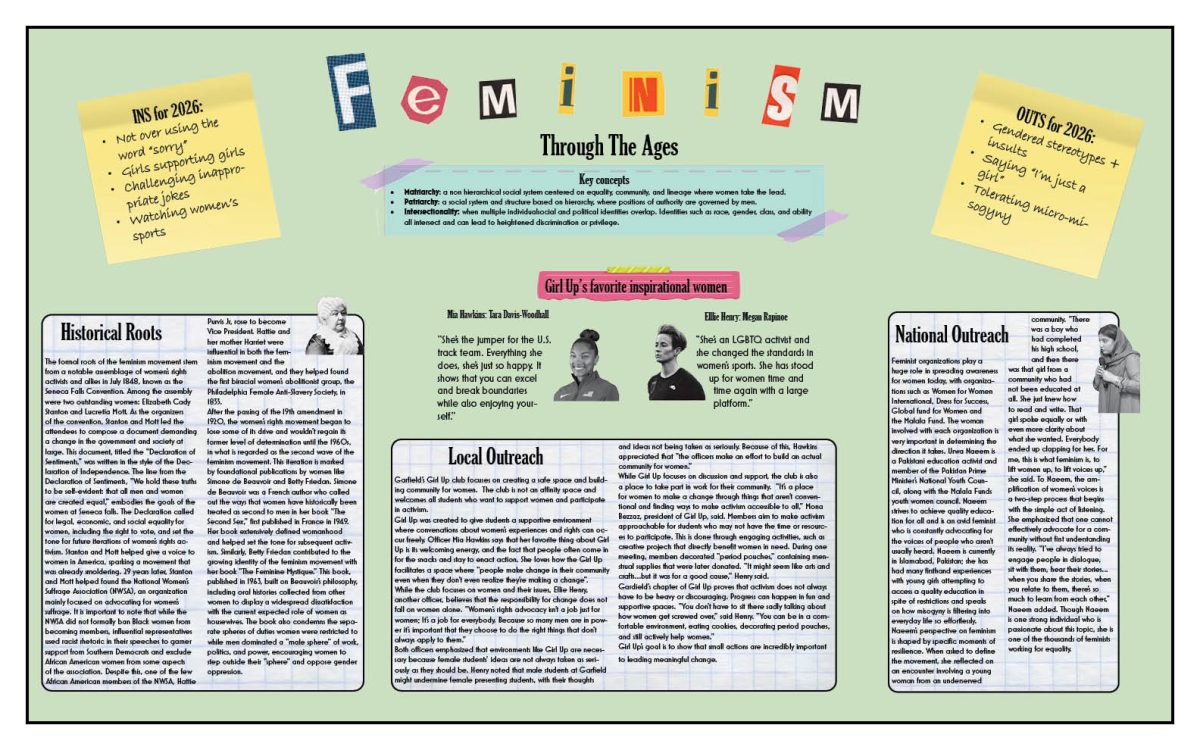
The formal roots of the feminism movement stem from a notable assemblage of women’s rights activists and allies in July 1848, known as the Seneca Falls Convention. Among the assembly were two outstanding women: Elizabeth Cady Stanton and Lucretia Mott. As the organizers of the convention, Stanton and Mott led the attendees to compose a document demanding a change in the government and society at large. This document, titled the “Declaration of Sentiments,” was written in the style of the Declaration of Independence. The line from the Declaration of Sentiments, “We hold these truths to be self-evident: that all men and women are created equal,” embodies the goals of the women at Seneca falls. The Declaration called for legal, economic, and social equality for women, including the right to vote, and set the tone for future iterations of women’s rights activism. Stanton and Mott helped give a voice to women in America, sparking a movement that was already smoldering. 29 years later, Stanton and Mott helped found the National Women’s Suffrage Association (NWSA), an organization mainly focused on advocating for women’s suffrage. It is important to note that while the NWSA did not formally ban Black women from becoming members, influential representatives used racist rhetoric in their speeches to garner support from Southern Democrats and exclude African American women from some aspects of the association. Despite this, one of the few African American members of the NWSA, Hattie Purvis Jr, rose to become Vice President. Hattie and her mother Harriet were influential in both the feminism movement and the abolition movement, and they helped found the first biracial women’s abolitionist group, the Philadelphia Female Anti-Slavery Society, in 1833.
After the passing of the 19th amendment in 1920, the women’s rights movement began to lose some of its drive and wouldn’t regain its former level of determination until the 1960s, in what is regarded as the second wave of the feminism movement. This iteration is marked by foundational publications by women like Simone de Beauvoir and Betty Friedan. Simone de Beauvoir was a French author who called out the ways that women have historically been treated as second to men in her book “The Second Sex,” first published in France in 1949. Her book extensively defined womanhood and helped set the tone for subsequent activism. Similarly, Betty Friedan contributed to the growing identity of the feminism movement with her book “The Feminine Mystique.” This book, published in 1963, built on Beauvoir’s philosophy, including oral histories collected from other women to display a widespread dissatisfaction with the current expected role of women as housewives. The book also condemns the separate spheres of duties women were restricted to while men dominated a “male sphere” of work, politics, and power, encouraging women to step outside their “sphere” and oppose gender oppression.
Local Outreach
Garfield’s Girl Up club focuses on creating a safe space and building community for women. The club is not an affinity space and welcomes all students who want to support women and participate in activism.
Girl Up was created to give students a supportive environment where conversations about women’s experiences and rights can occur freely. Officer Mia Hawkins says that her favorite thing about Girl Up is its welcoming energy, and the fact that people often come in for the snacks and stay to enact action. She loves how the Girl Up facilitates a space where “people make change in their community even when they don’t even realize they’re making a change”.
While the club focuses on women and their issues, Ellie Henry, another officer, believes that the responsibility for change does not fall on women alone. “Women’s rights advocacy isn’t a job just for women; It’s a job for everybody. Because so many men are in power it’s important that they choose to do the right things that don’t always apply to them.”
Both officers emphasized that environments like Girl Up are necessary because female students’ ideas are not always taken as seriously as they should be. Henry noted that male students at Garfield might undermine female presenting students, with their thoughts and ideas not being taken as seriously. Because of this, Hawkins appreciated that “the officers make an effort to build an actual community for women.”
While Girl Up focuses on discussion and support, the club is also a place to take part in work for their community. “It’s a place for women to make a change through things that aren’t conventional and finding ways to make activism accessible to all,” Mona Bezzaz, president of Girl Up, said. Members aim to make activism approachable for students who may not have the time or resources to participate. This is done through engaging activities, such as creative projects that directly benefit women in need. During one meeting, members decorated “period pouches,” containing menstrual supplies that were later donated. “It might seem like arts and crafts…but it was for a good cause,” Henry said.
Garfield’s chapter of Girl Up proves that activism does not always have to be heavy or discouraging. Progress can happen in fun and supportive spaces. “You don’t have to sit there sadly talking about how women get screwed over,” said Henry. “You can be in a comfortable environment, eating cookies, decorating period pouches, and still actively help women.”
Girl Up’s goal is to show that small actions are incredibly important to leading meaningful change.
National Outreach
Feminist organizations play a huge role in spreading awareness for women today, with organizations such as Women for Women International, Dress for Success, Global fund for Women and the Malala Fund. The woman involved with each organization is very important in determining the direction it takes. Urwa Naeem is a Pakistani education activist and member of the Pakistan Prime Minister’s National Youth Council, along with the Malala Funds youth women council. Naeem strives to achieve quality education for all and is an avid feminist who is constantly advocating for the voices of people who aren’t usually heard. Naeem is currently in Islamabad, Pakistan; she has had many firsthand experiences with young girls attempting to access a quality education in spite of restrictions and speaks on how misogyny is filtering into everyday life so effortlessly. Naeem’s perspective on feminism is shaped by specific moments of resilience. When asked to define the movement, she reflected on an encounter involving a young woman from an underserved community. “There was a boy who had completed his high school, and then there was that girl from a community who had not been educated at all. She just knew how to read and write. That girl spoke equally or with even more clarity about what she wanted. Everybody ended up clapping for her. For me, this is what feminism is, to lift women up, to lift voices up,” she said. To Naeem, the amplification of women’s voices is a two-step process that begins with the simple act of listening. She emphasized that one cannot effectively advocate for a community without first understanding its reality. “I’ve always tried to engage people in dialogue, sit with them, hear their stories…when you share the stories, when you relate to them, there’s so much to learn from each other,” Naeem added. Though Naeem is one strong individual who is passionate about this topic, she is one of the thousands of feminists working for equality.