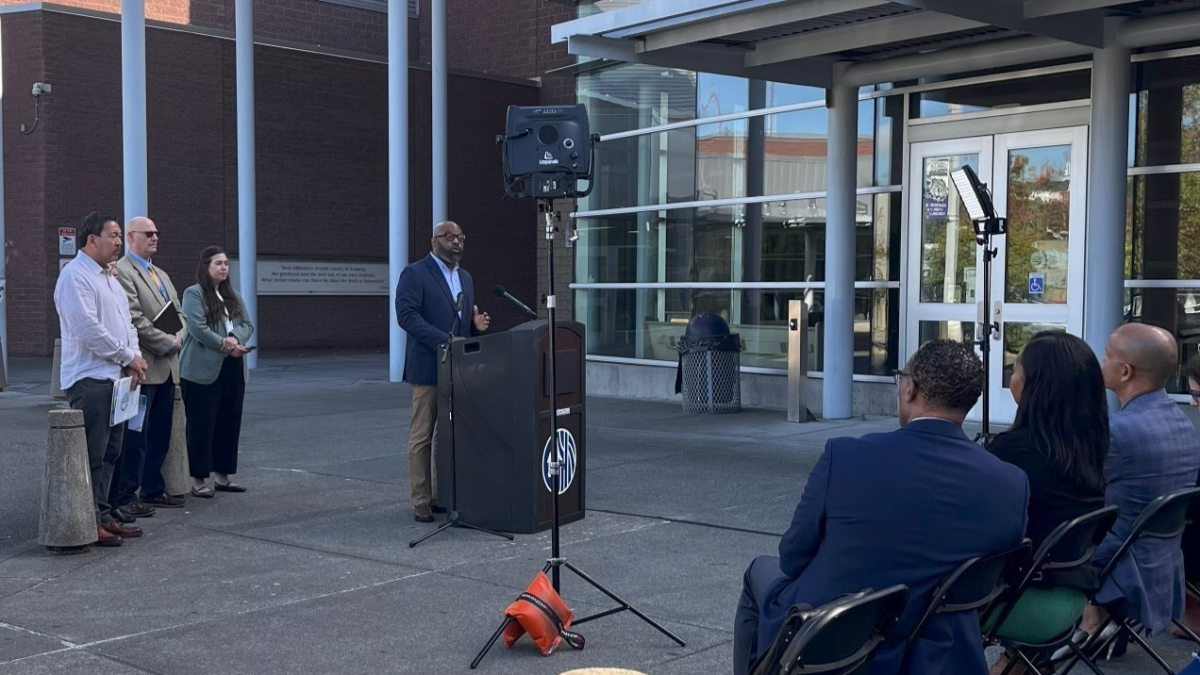


On November 4, as voting closed for the Seattle mayoral election, former Seattle mayor Bruce Harrel led by a large margin. However, progressive candidates are generally predicted to benefit from ballots collected later, and indeed, as predicted as more votes came in, Katie Wilson, a progressive challenger, closed the 6-point gap. On November 13, Bruce Harrel conceded the race to Wilson in what turned out to be one of the closest mayoral races in the country.
Katie Wilson, the new mayor-elect, was born and raised in New York and attended Oxford University in England, until six weeks before her final exam when she dropped out. She then moved to Seattle and worked in construction, boat repair, and other working class jobs. Alex Gallo-Brown, Wilson’s campaign manager and former member of The Messenger’s staff, feels that Wilson is well prepared to represent all of Seattle. “Katie is the rare mayor that has really worked jobs that the majority of Seattle has worked or works currently,” Gallo-Brown stated. “She spent time renovating apartments and standing on top of buckets. She’s cleaned boats and boatyards, and she’s worked all kinds of jobs, and I think what those experiences taught her was that there are people in the city and in the society who have very little voice within the political system.” During this time, she also became increasingly involved in Seattle protests. In 2011, Wilson co-founded the Transit Riders Union, a non-profit focused on making improvements to public transportation in Seattle and King County, in response to a proposal that would cut King County Metro budget by 17%. The cuts would have also eliminated the fare free zone downtown. Wilson helped to create Seattle’s JumpStart tax in 2020, a payroll tax on private employers which funded affordable housing. Wilson’s first criticism of Harrel came after he proposed that funds from the JumpStart tax would be redirected to balance the city budget deficit.
Katie Wilson announced her candidacy for mayor of Seattle in March 2025. Akey reason she decided to run was Harrel’s opposition to a ballot measure that would fund housing through a tax on business. Gallo-Brown stated that Harrel had “come out against that initiative and had wanted to draw an existing funding to pay for social housing from a separate bucket of funds,”. Wilson ran as a progressive, stating that her priorities were housing, homelessness, and protecting Seattle from the federal actions of the Trump administration.
When Harrell was first elected in 2021, he was one of many centrist, tech-friendly democrats to be elected across the West Coast. Wilson’s win in November highlights the change in national political momentum towards more progressive, democratic socialist, candidates in America. “A few years ago, there was certainly a consensus forming that the left didn’t know how to govern, and it was too radical and made a mess of the cities on the West Coast and across the country, and I think what people have seen is that moderate Democrats who came in have not solved the problems that they ran on,” Gallo-Brown said. “I think the voters seem to feel like ‘well, you know, let’s give let’s give the other side a chance.’”
On the East Coast, New York City mayor-elect Zohran Mamdani, a self-proclaimed democratic socialist, has captured attention across America. Comparisons between Wilson and Mamdani have been prevalent in coverage of the mayoral races, and the similarities are indeed striking. Like Seattle, New York City is in the midst of an affordability crisis, and affordability is the top priority for both Wilson and Mamdani. They have both proposed similar agendas: a focus on rent control, public transit, accessible childcare, and progressive tax codes. However, they are not just similar in terms of policy. They are both young, have similar backgrounds, and come from educated New York families. Furthermore, they are both often criticized for having little to no former experience in politics. Wilson has never served in office. Rebecca Thorpe, an Associate Professor of Political Science at the UW, says this will be “a serious hurdle, for her just to understand the environment” of being in office. Mamdani, on the other hand, has some political experience, serving for five years on the New York State Assembly. Moreover , Wilson and Mamdani will both replace centrist democratic incumbent mayors, Harrell and Eric Adams.
The parallels between the two mayors are a sign; the people of Seattle and New York are willing to trust visionaries with little experience, because the current system isn’t working for them. Centrist democratism isn’t upholding the balance between being a home for big businesses while also being the home for regular people. When cities become too expensive, people are looking to those who promise change, even if it means looking much fuarther left.
“It remains to be seen how they govern, and if they are able to deliver on their promises,” Thorpe said. The way the next four years go could show people that democratic socialism is ideal for big cities, like Seattle and New York. Now, it’s up to Mamdani and Wilson to see how socialism holds up under both economic and political challenges.